







.png?width=80&name=Alexander%20von%20Schirmeister%20(2).png)
Not that long ago, I was looped into a conversation about a potential customer. Their IT team had been exploring what they could build internally using AI. The question on the table was simple:
“Why are we paying for a system when we could build something ourselves using AI?”
I run a company that provides treasury management systems. It would have been easy to push back and to list reasons why that approach wouldn’t work or might end up costing more.
But…
If a serious team is asking that question, it deserves a serious answer. And in some cases, the answer might be that they should try to build it themselves. The key is understanding what that decision actually involves.
Why this question keeps coming up
AI has become widely accessible. You can build simple applications quickly, often just by describing what you want. People see this and naturally ask what else could be built.
That curiosity makes sense.
But there’s an important distinction: There is a gap between building something and running it.
We’ve seen this before.
A decade ago, companies asked why they should move to the cloud instead of building and managing systems internally. The comparison often started with cost but rarely ended there.
The real challenge wasn’t building the system. It was everything that came after.
Things like keeping systems running and secure. Handling updates. Meeting audit requirements. Dealing with changes in external systems. Making sure things worked every time, and not just most of the time.
Many companies could build their own systems. Some did. Most eventually chose not to, because they didn’t want to carry that long-term responsibility.
AI makes it easier to build.
It does not change what it takes to run a system.
To be clear, internal teams can build parts of a treasury stack today. Teams can connect to banks. They can pull data into their own environment. They can build dashboards and reports. They can use AI to support forecasting and analysis. If the question is whether this is possible, the answer is yes in many cases.
The challenge begins when you move beyond the first version.
In many of the conversations I have seen, the reasoning follows a familiar pattern. We can connect our main banks. We can handle forecasting. We already have data infrastructure.
All of that may be true. But it leaves out the part that tends to matter most.
In reality, someone still needs to answer a set of questions that are less visible at the start.
-
Who maintains those bank connections when formats change, or new requirements are introduced?
-
Who makes sure payments go through every time, including when something unexpected happens?
-
Who handles audit requirements and makes sure there is a clear and complete record of what happened and why?
-
Who monitors transactions for unusual patterns and potential fraud on an ongoing basis?
-
Who keeps up with regulatory changes across the markets?
-
What happens when the person who designed the system is no longer there?
These situations are all part of the normal operation of treasury.
There’s an assumption behind many of these discussions: If AI makes systems easier to build, it should also make them easier to run.
In practice, these are two fundamentally different problems.
-
AI can help you create functionality. It can help you move faster. It can help you work with data in more flexible ways.
It does not take ownership of the system. It does not carry responsibility. It does not ensure that everything works as expected in every situation. -
Systems still need to be maintained. Issues still need to be resolved. Risks still need to be managed. Decisions still need to be documented and explained.
None of that changes because AI was used to build the system.
If anything, faster development can lead to more systems, and more to maintain.
There are situations where it works.
If a company is willing to take full ownership, it’s a valid choice. That means being willing to own and maintain critical financial infrastructure over time. It means having the resources to keep the system reliable as requirements change. It means managing compliance and audit requirements on an ongoing basis. It means being comfortable with the level of dependency on internal expertise.
The companies most likely to succeed with this approach are those whose core capability is building and operating software at scale.
For others, the calculation tends to look different.
Treasurers are, by nature, risk-aware and pragmatic. Most quickly recognize: Just because we can build something doesn’t mean we want to run it indefinitely.
They choose to focus their internal resources on areas that are closer to their core business. The things they’re the best at. They prefer to rely on systems that are designed to handle the ongoing demands of cash management and treasury operations.
Treasury systems are not just a collection of features. They are an ongoing operational commitment.
None of this means treasury should ignore AI.
Quite the opposite.
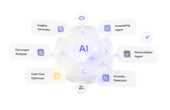
There are clear areas where AI can add value in treasury. Things that it’s good at.
Identifying patterns. Improving forecasting by working with historical data and current inputs. It can support the detection of unusual activity. It can simplify reporting and make it more convenient to explore data.
These are meaningful improvements, and they are worth pursuing.
They tend to deliver the most value when they are applied on top of systems that are already reliable and well-controlled. Systems where data is consistent, processes are defined, and responsibilities are clear.
We don’t see this as a choice between AI and systems.
We are investing in AI, and embedding it into our platform, but with a clear approach: We focus on use cases that solve real problems, and we validate them with our customers before we scale them. We are clear about what works well and where the limits are. We are equally clear about the implications when it comes to security, compliance, and control.
In treasury, those things are not secondary considerations. They are part of the core requirement.
The original question was a good one.
It reflects a real shift in what’s possible, and a healthy willingness to rethink existing choices.
Building your own treasury system is more achievable today than ever.
Running one is just as demanding as it has always been.
If a company is ready to take that on, it can make sense.
Most companies decide they are not.

