








Treasury teams often know exactly where the problems are.
Cash positions take too long to prepare. Payments rely on several portals, formats, and approval steps. Forecasts depend on spreadsheets and delayed inputs. Controls work, but only because experienced people know how to keep the process together.
The challenge is not always identifying the problem. It is proving the business impact.
A business case for treasury automation needs to show more than “we need better software”. It needs to explain where the current setup creates cost, risk, and unnecessary effort — and how automation can improve visibility, control, and predictability across daily treasury operations.
That makes treasury automation ROI a practical question: how much time could be saved, how much manual work could be reduced, and how much more confidently could treasury support decisions around payments, liquidity, forecasting, and risk?
Start with the current operating reality
A strong business case begins with the way treasury works today.
-
How are balances collected?
-
How many banks and entities are involved?
-
How are payment files prepared, approved, and released?
-
How are forecast inputs gathered?
-
Which processes still depend on spreadsheets, email updates, or local workarounds?
These questions matter because manual treasury work is often hidden inside daily routines. A cash position may require several data sources. A payment run may involve different portals and approval flows. A forecast may only be ready after multiple teams have sent updates.
None of these looks like a major issue on its own. But together, it creates operational drag.
The business case becomes stronger when these routines are described clearly: what takes time, what causes delays, what increases dependencies, and where the treasury lacks a reliable view.
Quantify the time spent on manual work
Time savings are often the easiest starting point.
Look at recurring tasks across cash management, payments, forecasting, reconciliation, and reporting. Estimate how many hours are spent each week collecting data, checking files, updating spreadsheets, resolving exceptions, or preparing reports for management.
The goal is not to suggest that automation removes the need for treasury expertise. It does the opposite. It gives treasury teams more time to use that expertise where it matters: reviewing liquidity, improving forecasts, managing exceptions, supporting funding decisions, and answering leadership questions with confidence.
This is where treasury automation ROI becomes more tangible. If a team spends significant time preparing data before it can analyse anything, there is a measurable cost to the current process.
Include the value of better cash visibility
Cash visibility is often one of the clearest business case drivers.
When treasury has to collect balances from several banks, entities, and systems, the organisation may technically have the data, but not always when it is needed. By the time the information is consolidated, it may already be outdated.
That delay affects decision-making. Treasury may not have a reliable view of where cash is available, where liquidity is needed, or how future positions are developing.
Better cash visibility supports more than reporting. It helps treasury understand today’s position, monitor movements, identify liquidity gaps earlier, and provide the CFO with more reliable information.
Show the impact of payment automation
Manual payment processes often involve multiple banking portals, file formats, tokens, approvals, and local variations. This increases the time spent preparing and checking payments. It also makes oversight harder, especially when companies operate across several entities and banks.
Payment automation benefits can include more consistent workflows, fewer manual uploads, clearer approvals, stronger audit trails, and better visibility over payment status.
For leadership, the value is not only that payments move faster. It is that payment processes become easier to control, easier to monitor, and easier to explain.
Connect forecasting to decision quality
A cash forecasting business case should not only focus on how long the forecast takes to prepare.
The larger question is whether treasury can provide reliable forward-looking insight when the business needs it. If forecasts depend on manual inputs and delayed updates, treasury spends too much time gathering information and too little time analysing what it means.
Automation can support a stronger forecasting process by improving data availability, reducing manual consolidation, and making it easier to compare expected and actual positions.
This matters because forecasting is not just a treasury task. It supports funding decisions, liquidity planning, working capital discussions, and scenario analysis. A better forecast gives the business more time to act.
Build the case around measurable outcomes
A useful business case should translate treasury complexity into outcomes that other stakeholders understand.
For the CFO, that may mean ROI, cost control, cash visibility, and stronger confidence in liquidity decisions. For treasury, it means less manual work, better oversight, and more reliable processes. For IT, it means fewer fragmented connections and a more manageable system landscape. For procurement, it means clearer TMS cost savings and a stronger total cost argument.
-
The business case should therefore answer three questions:
-
What does the current process cost us?
-
Where does it create risk or delay?
-
What would improve if treasury had better visibility, automation, and control?
-
This keeps the conversation focused on value, not features.
-
Estimate your treasury automation ROI
Many treasury teams know their current setup is inefficient, but they do not yet have a number that supports the investment discussion.
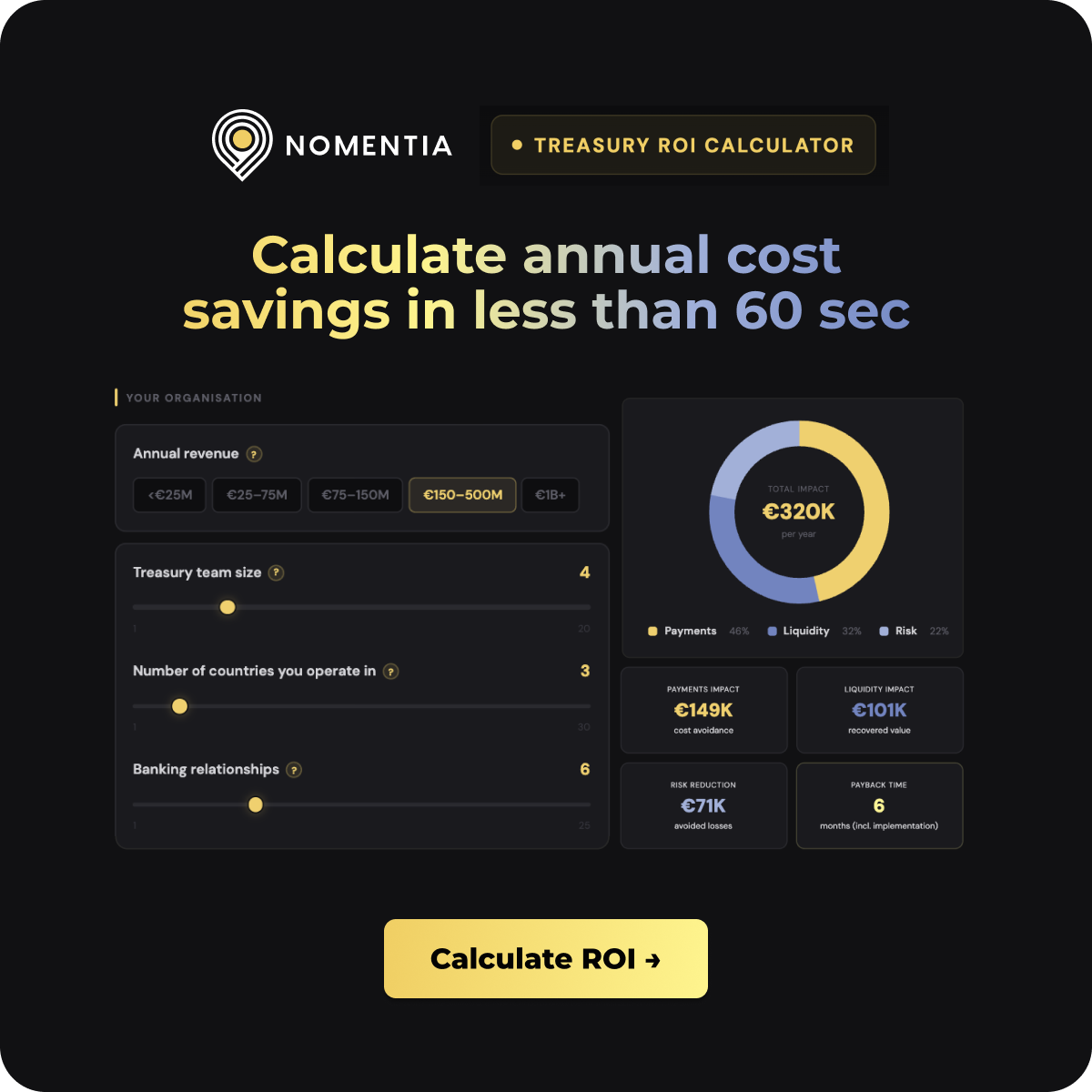
The Nomentia Treasury ROI Calculator helps turn that operational reality into a clearer estimate. It allows treasury and finance teams to calculate potential time and cost savings across payments, liquidity, forecasting, and control.
It is not a final investment model. It is a practical starting point for building a business case, aligning stakeholders, and understanding what better treasury operations could be worth.
For teams evaluating treasury automation, cash management software, payment automation, or a treasury management system, the calculator helps answer one important question:
How much could your organisation save by replacing manual treasury work with clearer, more controlled, and more automated processes?