

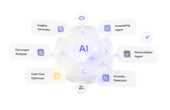







Treasury teams spend a surprising amount of time retrieving information that already exists in their systems.
A user wants to know the current cash position by bank and currency. A payment manager needs to understand which transactions were rejected today. The CFO asks how much was paid to a particular counterparty last month. A new colleague wants to know how to set up a process correctly.
The information may already be available, but getting to it often depends on knowing the right screen, filter, report or colleague.
Nomentia AI provides a natural-language access layer across licensed Nomentia capabilities. Users can ask questions in normal business language and receive an answer based on the live data they are authorised to access, without turning every ad-hoc question into a navigation or spreadsheet exercise.
Natural language becomes another way into the treasury platform
The purpose is not to create a general-purpose chatbot inside treasury. Nomentia AI is designed to answer questions about the customer’s own treasury environment.
A user can ask about bank accounts, balances, statements, payments, direct debits, payment statuses, entities, deals, FX rates, users and roles where those capabilities are available and licensed. Product-help questions can also be answered in context.
Answers can be presented as plain-language explanations, tables or charts. Where useful, users can create reports that persist beyond the conversation and can be reused later.
Conversation context also carries into follow-up questions, reducing the need to rebuild the scope each time. A user can start with a broad question, narrow the period or entity and then ask for a different view of the same result.
The answer follows the user’s permissions
Natural-language access does not create a new data boundary.
Nomentia AI operates within the role and entity scope of the person asking the question. If the user cannot access a bank account, entity or licensed module through the underlying platform, the AI does not gain access to it on the user’s behalf.
This is important for treasury teams where segregation of duties and controlled access are part of daily operations. A conversational question should be easier to ask, while the authorisation model behind it remains unchanged.
The same principle also applies when the interaction comes from an approved external AI client.
The model interprets; platform services calculate
One of the most important design boundaries concerns financial calculations.
Nomentia AI does not generate positions, conversions or financial aggregates from model memory. The AI interprets the user’s intent and calls governed Nomentia platform services. Those services retrieve the relevant live tenant data and perform the deterministic calculation. The model then composes the result into an understandable answer.
This separation means the language model is used where it adds value - understanding language, selecting the appropriate service and explaining the result - while financial logic remains within the system designed to calculate it.
For treasury users, that provides a clearer basis for trusting the number behind the answer.
From answering questions to assisting with tasks
Some interactions can go further than information retrieval.
Nomentia AI can support assistant-level actions where these are made available, such as selected administrative tasks. The system drafts what it is about to do and requires explicit user confirmation before a change is applied.
That confirmation creates a clear boundary between an AI suggestion and an executed action. The user has the opportunity to review the intended change rather than allowing the model to act silently.
Existing approval processes remain separate. The AI does not approve payments or bypass module-level workflow controls. It can help users understand the situation and prepare the next step, while the authorised process continues to determine who can approve what.
AI agents can use the same governed services
The AI interaction does not have to begin inside the Nomentia interface.
Through Model Context Protocol (MCP), approved MCP-capable AI clients and agents can access the same Nomentia platform services using the user’s authentication. The request remains subject to the same permissions, control rules, audit logging and usage governance.
This matters as companies begin building broader AI workflows across finance. A treasury team may prefer to work from an approved enterprise AI client like Copilot/Claude or connect a custom agent to several internal systems. MCP provides a governed interface into Nomentia rather than requiring teams to export financial data and recreate the control logic elsewhere.
The channel changes. The treasury permission model does not.
What an AI agent can currently do
The current capability is best understood as assisted and augmented work rather than autonomous treasury.
Once a user asks a question, the system can automate intent interpretation, tool selection, data retrieval, deterministic calculation, answer composition, chart generation, help search and audit logging. For supported changes, it can prepare the action for review.
The user still defines the request, reviews the answer, decides what to do and confirms proposed changes. Existing module approvals remain with the authorised human roles.
Nothing needs to run unprompted for the capability to create value. A large part of the daily efficiency opportunity comes from reducing the time required to find information and assemble evidence.
Daily treasury questions become easier to answer
The most practical use cases are often ordinary questions rather than ambitious autonomous workflows.
At the start of the day, treasury can ask what balances arrived overnight or which payment items require attention. During payment operations, a user can ask which payments were rejected and why. Before a management meeting, treasury can retrieve balances by entity, bank or currency without manually rebuilding the view. An analyst can investigate a counterparty or account while remaining in the same conversation.
The common benefit is speed-to-answer. The user spends less time moving through the system and more time interpreting the information and deciding whether any action is required.
Ad-hoc questions no longer have to run through one expert
Treasury teams often have a hidden system dependency: one or two people know where everything lives.
They become the human search engine for the rest of the team. Questions from colleagues, management and new joiners interrupt their own work, while everyone else waits for an answer.
Natural-language access can distribute more of that system knowledge. Users do not need to memorise the exact navigation route before they can retrieve information, and product-help questions can be answered in the moment.
This does not remove the need for treasury expertise. It reduces the amount of expert time spent on locating information that the system already contains.
A governed alternative to copy-paste AI
General-purpose AI has created another practical use case: users increasingly want to analyse their work through the AI tools they already use.
Without a governed connection, the easiest workaround is often an export. Data leaves the treasury environment, permissions are reduced to whatever the user chose to copy, and the resulting interaction may sit outside the organisation’s normal audit model.
A governed AI layer provides a different route. Data is retrieved at ask-time from the platform under the user’s permissions. Customer content is not used to train third-party language models and, under Nomentia’s AI service terms, is not retained by model providers.
For organisations developing an enterprise AI strategy, this makes treasury participation easier to govern.
Auditability applies in-product and through agents
Every AI interaction should remain part of the controlled environment.
Nomentia’s design records AI calls in the audit trail, including interactions initiated through the MCP channel. Supported confirmed changes are executed through the normal platform services and recorded accordingly.
This gives treasury and IT a common control model even when users access the platform through different AI interfaces.
If the AI service itself is unavailable, the underlying Nomentia modules continue to operate. The AI layer is an accelerator to the treasury process rather than a dependency for core execution.
Where Nomentia AI fits alongside Analytics and Predictive Forecasting
Nomentia AI is a horizontal access layer and should be distinguished from other intelligence capabilities in the Smart Treasury Suite.
Analytics provides recurring standard reports and controlled self-service reporting, particularly across payment data. Predictive Forecasting uses historical liquidity transactions to generate an independent statistical reference forecast. Nomentia AI provides the conversational route into the live treasury information and supported services available to the user.
The capabilities complement one another. Analytics supports the recurring picture, Predictive Forecasting adds a forward-looking benchmark and Nomentia AI helps users interrogate the information or complete supported tasks in natural language.
Faster access works because the control model stays intact
The promise of AI agents in treasury is easy to describe: ask the system directly, get the answer sooner and allow software to handle more of the routine work.
The harder part is making that useful in a financial environment where permissions, calculations, approvals and accountability matter.
Nomentia AI is designed around that boundary. It gives users and approved agents a faster way to interact with treasury information while keeping financial calculations in platform services, limiting access to the user’s rights, requiring confirmation before supported changes and preserving the existing human approval structure.
That is what makes faster answers practical for treasury: the path to the information becomes shorter without making the controls around it weaker.
Frequently Asked Questions (FAQ)
What is Nomentia AI?
Nomentia AI is a natural-language access layer across licensed Nomentia capabilities. It lets users ask questions about their treasury environment and receive answers, tables or charts based on live, permission-scoped platform data.
What is an AI agent in the context of Nomentia?
Does Nomentia AI calculate financial figures itself?
Can AI approve or execute payments?
Does customer data train third-party AI models?