







Operational payment data should not need a reporting detour
Every payment processed through Nomentia creates information finance can use: value, currency, date, counterparty, entity, account, payment type, geography, status and bank response.
Nomentia Advanced Analytics brings reporting closer to that operational data. Instead of treating the payment platform as a source to export from, treasury can use out-of-the-box dashboards and reports directly inside the Nomentia environment.
The first focus is Payments, where recurring reporting needs are already clear and the underlying data is structured enough to support repeatable analysis.
Out-of-the-box dashboards cover the questions finance asks repeatedly
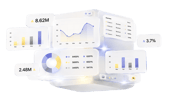
Nomentia maintains a set of best-practice dashboards and reports for common payment analysis. These can cover payment value and volume, currencies, counterparties, countries, payment types, cross-border activity, rejection patterns and transaction-level detail.
The benefit is consistency. Treasury does not have to recreate the same logic every reporting cycle, and management receives a familiar baseline that can be compared from one period to the next.
For recurring questions, the report should already be there.
The reporting layer stays connected to the payment detail
A management dashboard is useful only if treasury can explain the movement behind it.
Users can move from aggregated views into the relevant entities, currencies, counterparties or individual payments. That connection between summary and source helps treasury investigate unusual movements without starting another reconciliation exercise outside the platform.
It also makes the reporting more defensible: the high-level number remains connected to the operational transaction.
Self-service reporting adds flexibility where the standard view stops
Treasury teams will always have organisation-specific questions. A particular management pack may require a different grouping, a bank review may need another cut of the data, or an audit request may require a view that does not belong in the standard dashboard library.
Self-service reporting lets customers build additional views on the same governed payment data.
Nomentia owns and maintains the logic of its out-of-the-box reports. Customer-built reports remain the customer’s responsibility. This gives teams flexibility while keeping the reporting ownership clear.
Nomentia AI helps with the long tail of ad-hoc questions
Some questions do not justify another permanent report. A CFO may ask which bank had the most rejected payments this month. Treasury may want to compare the largest counterparties with the previous period. An analyst may need a quick view of payment activity for one entity before a call.
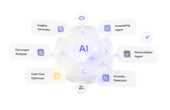
With Nomentia AI, users can ask ad-hoc questions in natural language to the data and dashboards available within their permissions.
The practical value is speed. The user can approach the information through the question rather than first translating the question into filters, exports and spreadsheet logic.
The permission model remains part of the answer
Faster reporting should not create a separate access model.
Nomentia Advanced Analytics and Nomentia AI operate within the governed Nomentia environment. Users see the data that matches their authorised scope, including the relevant entities and accounts.
That matters when self-service and natural-language access make it easier for more users to work directly with financial data. The route to the answer becomes simpler; the access boundary does not.
Different reporting needs can require different refresh speeds
Not every report serves the same operational purpose. Some views support current payment oversight, while broader analytical dashboards may refresh on a different cadence.
Treasury should understand how current a view is before using it for an operational or management decision. Data freshness is therefore part of the reporting context, not a detail hidden behind the dashboard.
The objective is a reliable answer for the question at hand, not a blanket claim that every analytical view is real time.
Rejection analysis is a good example of data becoming actionable
Payment status data becomes more useful when treasury can see patterns rather than individual exceptions in isolation.
A dashboard can show whether rejection volumes are changing, which reason codes are most common, whether one bank or payment type is overrepresented, and which transactions sit behind the pattern.
Nomentia Advanced Analytics does not decide what treasury should do about the pattern. It gives the team a faster and more structured basis for deciding whether the issue requires operational follow-up, a bank discussion, or a process change.
Payments are the first scope; the treasury value is broader
The current focus on Payments should be stated clearly. Nomentia Advanced Analytics starts from payment data already processed through the platform rather than presenting itself as a universal reporting layer across every treasury dataset from day one.
The value for treasury is still broad because payments are one of the clearest records of cash leaving the organisation. Analysing them supports cash oversight, bank management, management reporting, exception investigation and discussions with the CFO.
The product starts with a well-defined dataset and makes that dataset more useful. Other processes follow directly.
A better reporting process starts with less rebuilding
The strongest outcome is not a larger dashboard library. It is a reporting process that requires less repetitive preparation.
Recurring questions can begin from maintained dashboards. Organisation-specific questions can move into controlled self-service reporting. Ad-hoc questions can be approached through natural language with Nomentia AI.
That gives treasury more time for the part of reporting that still requires expertise: understanding why something changed, deciding whether it matters and explaining the implication to the business.
Frequently Asked Questions (FAQ)
What data is the initial focus of Nomentia Advanced Analytics?
The current focus is payment data already processed through Nomentia, including values, currencies, counterparties, entities, accounts, payment types, statuses and bank responses. Others follow in the next release directly.
What is the difference between out-of-the-box and self-service reporting?
Out-of-the-box dashboards and reports are maintained by Nomentia. Self-service reporting allows customers to build additional views on governed data, with the customer owning and validating that custom logic.
How does Nomentia AI fit with Advanced Analytics?
Nomentia AI gives authorised users a natural-language route to ad-hoc questions against available data and dashboards, complementing the recurring dashboards and self-service reporting model.