







What is the role of natural-language reporting?
Nomentia AI gives authorised users a faster way to ask ad-hoc questions against available data and dashboards without rebuilding every answer in a spreadsheet or separate report.
Cash visibility is the starting point, not the final answer
Treasury cannot manage liquidity without knowing where cash is. Consolidated balances across banks, accounts, entities and currencies remain one of the most important foundations of day-to-day treasury.
But once that position is visible, the next questions arrive immediately. Why did payment volumes change? Which entities or currencies drove the movement? Which counterparties account for the largest outflows? Are rejections concentrated at one bank? What changed compared with the previous period?
Cash visibility answers where the money is. Modern treasury increasingly needs to explain what is happening around it.
The reporting problem often starts after the data is already available
A large part of treasury reporting is still built around data that already exists in operational systems. Payment values, currencies, counterparties, entities, dates, statuses and bank responses are captured during the payment process, yet many teams still export that information into spreadsheets before it becomes useful for management.
The result is a familiar monthly routine: export, clean, restructure, check, compare, format and explain. The work is not caused by missing data. It is caused by the distance between operational data and a report finance is comfortable using.
Nomentia Advanced Analytics is intended to shorten that distance.
Out-of-the-box dashboards change the starting point
The most useful reporting questions are often the ones treasury asks repeatedly. Payment value and volume over time, currency mix, largest counterparties, geographic distribution, payment types and rejection patterns are not one-off questions. They are recurring parts of payment oversight and management reporting.
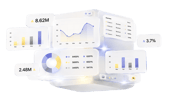
Nomentia Advanced Analytics brings out-of-the-box dashboards and reports into the same environment as the operational data. The reporting logic is maintained by Nomentia, giving users a consistent baseline instead of requiring every customer to rebuild the same views.
That matters because repeatable reporting should not depend on repeatable manual work.
A trusted baseline leaves more time for interpretation
When a report is already available, the treasury analyst can begin with the result rather than with the preparation of the result.
A rise in rejected payments becomes something to investigate. A concentration in one currency or counterparty becomes something to explain. A change in payment volumes becomes something to compare with business activity, liquidity expectations or bank usage.
The value is therefore not the dashboard itself. It is the analyst time that moves from assembling information to understanding it.
Self-service matters because not every question is standard
No fixed dashboard set can cover every organisation-specific request. Treasury teams have different entity structures, bank relationships, management routines and reporting expectations.
Self-service reporting gives finance teams room to build additional views on the same governed data when the standard dashboards do not answer the full question. The important boundary is ownership: Nomentia maintains the out-of-the-box reporting logic, while customer-built reporting remains owned and validated by the customer.
That distinction keeps flexibility without blurring which reports have a common, maintained definition and which reflect organisation-specific logic.
Natural-language access shortens the route to an ad-hoc answer
The longest reporting requests are often not the recurring ones. They are the unexpected questions that arrive during a management discussion, before a board meeting or while treasury is investigating an exception.
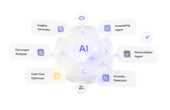
With Nomentia AI, users can ask ad-hoc questions in natural language against the data and dashboards they are authorised to access. Instead of starting another export or asking an analyst to create a new report, the user can approach the information through the business question itself.
This is particularly useful for the long tail of questions that are important enough to answer, but not important enough to justify a permanent dashboard.
Natural language does not remove the reporting hierarchy
A conversational answer, an out-of-the-box dashboard and a customer-built report do not serve exactly the same purpose.
The standard dashboard remains the consistent baseline for recurring questions. Self-service reporting provides controlled flexibility for organisation-specific views. Natural-language interaction makes exploration and ad-hoc access faster.
Keeping those roles clear is important. Faster access should not make it harder to understand where an answer came from or who owns the logic behind it.
The ability to drill down is part of CFO-ready reporting
CFO-ready insight does not mean reducing everything to a single number. It means being able to support the number when the next question comes.
If a dashboard shows a change in payment volume, treasury should be able to move into the entities, currencies, counterparties or individual transactions behind it. If a rejection pattern appears, the team should be able to investigate the relevant bank responses and payment details.
The summary is useful because the evidence remains connected to it.
Payments are the first focus because the data is already rich
Nomentia Advanced Analytics currently starts with payment data. That is a practical place to begin because payments already contain a detailed record of outgoing cash activity: who was paid, how much, in which currency, from which entity, through which bank and with what execution result.
For treasury, that information supports more than payment operations. It contributes to liquidity discussions, bank management, audit responses and management reporting.
The objective is to make that operational data useful earlier, before another manual reporting layer is built around it.
Cash visibility becomes more valuable when finance can explain the activity around it
Visibility remains essential. Treasury still needs a reliable current position before it can make funding, investment or liquidity decisions.
Nomentia Advanced Analytics extends that foundation by helping finance understand the activity that shaped the position and by making recurring and ad-hoc questions faster to answer.
The result is not more reporting for its own sake. It is a shorter path from financial data to an explanation treasury can use with the CFO.